
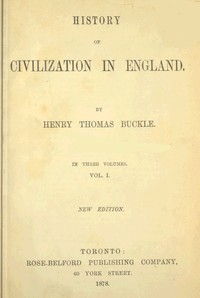
History of Civilization in England, Vol. 1 of 3 by Henry Thomas Buckle
This isn't your typical history book. Buckle doesn't start with 1066 or the Magna Carta. He starts with a big idea: human history, like the natural world, must operate by discoverable laws. 'History of Civilization in England' is his attempt to prove it. The first volume sets up his entire theory. He argues that progress happens when people move from being controlled by fear (of nature, of superstition) to using reason and accumulating knowledge.
The Story
There's no traditional plot with characters. The "story" is Buckle building his argument, piece by piece. He compares the development of Europe to that of other continents like India and South America. He looks at factors often ignored: climate, soil fertility, food supply, and how they influence a society's character. He then examines how these physical conditions shape mental habits, which in turn determine whether a society values authority or encourages free inquiry. A lot of the book is him gathering evidence—from crop yields to literary trends—to support his central thesis that civilization advances through the intellectual, not the moral, improvement of mankind.
Why You Should Read It
You should read this not for facts and dates, but for the thrill of a big, sweeping idea. Buckle's confidence is infectious. Even when you think he's oversimplifying or disagree with his conclusions, you're forced to think bigger about what drives history. It’s like watching a master architect explain the blueprint for a building that will house all of human experience. His focus on environment and statistics was way ahead of its time. Reading him, you feel the excitement of the 19th-century belief that science could explain everything, even us.
Final Verdict
This book is perfect for the curious reader who loves big ideas and doesn't mind a challenging, opinionated guide. It's for anyone who enjoys authors like Jared Diamond or Yuval Noah Harari and wants to see an earlier, grand attempt to make sense of the human story. It's not a light read—Buckle's sentences can be dense—but it's incredibly rewarding. If you want a history that argues instead of just narrates, start here. Just be ready to have your own views on what makes societies tick challenged on every page.
Thomas King
5 months agoAmazing book.
William Wilson
8 months agoAmazing book.
Kenneth Lewis
6 months agoThis book was worth my time since the flow of the text seems very fluid. Thanks for sharing this review.
Emma Jones
1 year agoCompatible with my e-reader, thanks.
Patricia Miller
1 year agoFast paced, good book.