
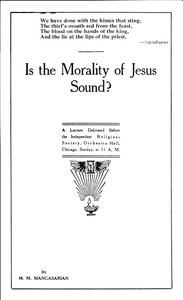
Is the Morality of Jesus Sound? by M. M. Mangasarian
Published in 1909, M. M. Mangasarian's book is a direct challenge. It doesn't tell a story in the traditional sense. Instead, it stages an argument. Mangasarian, who left the ministry to become a prominent secular speaker, acts as both prosecutor and judge. He takes the recorded moral sayings of Jesus from the New Testament—teachings on non-resistance, poverty, forgiveness, family, and justice—and questions their soundness for building a healthy, fair, and progressive society.
The Story
There's no plot, but there is a clear progression. Mangasarian starts by defining what makes a moral teaching 'sound'—basically, does it promote human welfare, justice, and growth here and now? Then, he goes line by line. He examines 'resist not evil' and asks if that empowers bullies. He looks at 'blessed are the poor' and questions whether it discourages the fight against poverty. He analyzes the emphasis on blind faith and the afterlife, arguing it can devalue critical thought and real-world justice. Each chapter tackles a different pillar of Christian ethics, contrasting it with principles from secular philosophy and common sense.
Why You Should Read It
This book is a mental workout. It's not about faith or disbelief; it's about the practical consequences of ideas. I found myself constantly pausing, arguing with the page, and re-examining my own assumptions. Mangasarian writes with the fervor of a convert (away from religion), and his passion is contagious. Even when I disagreed, I admired the blunt clarity of his challenge. He forces you to separate 'what is traditionally taught' from 'what actually works for human flourishing.' It's less an attack and more a rigorous stress test of moral axioms we often accept without scrutiny.
Final Verdict
This is for the intellectually curious reader who isn't afraid of controversial questions. It's perfect for book clubs that love a good debate, for students of philosophy or religious history, or for anyone who has ever wondered if our most common ethical phrases hold up under pressure. You don't have to be an atheist to appreciate it—you just need a willingness to think critically about the bedrock of Western morality. Fair warning: it will likely irritate devout Christians, but for everyone else, it's a fascinating, provocative slice of early 20th-century freethought that still echoes loudly today.
Elijah Miller
3 months agoA must-have for anyone studying this subject.
Richard Flores
9 months agoI was skeptical at first, but it creates a vivid world that you simply do not want to leave. A valuable addition to my collection.




Jessica Harris
4 months agoI had low expectations initially, however the flow of the text seems very fluid. A valuable addition to my collection.