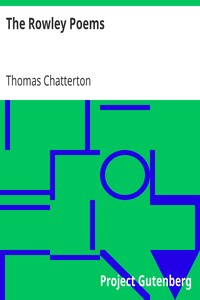
The Rowley Poems by Thomas Chatterton
Okay, let's clear this up first: 'The Rowley Poems' isn't a novel with a plot. It's a collection of poetry, but the story around it is what makes it incredible. In the 1760s, a teenage Thomas Chatterton, working as a legal apprentice, started 'discovering' manuscripts in a Bristol church. He claimed they were written by a 15th-century monk named Thomas Rowley. The poems were full of chivalry, medieval saints, and elaborate, archaic language. He sent them to scholars and patrons, hoping for money and fame.
The Story
The 'story' is the hoax itself. Chatterton painstakingly fabricated an entire world. He created Rowley's biography, his friends, and his historical context. The poems themselves tell tales of medieval Bristol—battles, love songs, elegies for lost greatness. But the real narrative is Chatterton's desperate attempt to sell this fiction. He needed these poems to be real so he could escape his grim life. The tension comes from watching this brilliant, isolated boy try to convince the powerful, skeptical men of London that his beautiful creation is a historical fact. It's a high-stakes con game played with sonnets and ballads.
Why You Should Read It
You read this book for the eerie double vision it gives you. On one level, you can appreciate the poems. They're melodious, gloomy, and vividly imaginative. But on another, you're constantly aware they're a performance. Every 'thee' and 'thou,' every mention of a 'rede' (speech) or 'afeard' (afraid) was a conscious choice by a teenager mimicking a past that never existed. It makes you think about why we value 'antiquity' and 'authenticity.' Chatterton's tragic life—his poverty, his pride, his ultimate despair—hangs over every line. It's less about medieval England and more about the terrifying power of a creative mind pushed to its limits.
Final Verdict
This is for the curious reader who loves a good historical mystery with a side of melancholy. It's perfect if you're interested in literary history, forgery stories, or tragic prodigies. Don't go in expecting a straightforward narrative. Go in ready to explore a strange artifact: a beautiful lie that tells a profound truth about art, ambition, and a boy who wanted to be remembered so badly he invented a past to secure his future. It's a quick, haunting read that sticks with you.