
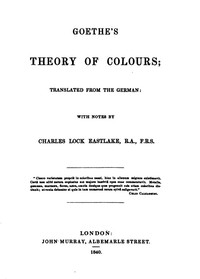
Goethe's Theory of Colours by Johann Wolfgang von Goethe
Published in 1810, Theory of Colours is Johann Wolfgang von Goethe's massive, life-long project that sits at a crazy crossroads. It's part science, part philosophy, and a huge part poetic rebellion. Goethe, the genius behind Faust, wasn't satisfied with how science explained the world. He thought it was too cold and mechanical.
The Story
There's no plot in the traditional sense, but there's a clear mission. The book is Goethe's argument against Sir Isaac Newton's famous prism experiments. Newton said white light contains all colors, and a prism just separates them. Goethe said no way—he believed color is created by the dynamic interaction of light and dark. He filled hundreds of pages with his own experiments: looking at colored papers through prisms, staring at candles against dark backgrounds, studying how colors appear at edges and in shadows. He meticulously documented what he called 'physiological' colors (the ones that happen in our eye, like afterimages) and 'physical' colors (the ones in things like soap bubbles). The 'story' is his journey to build a whole new system for understanding color from the ground up, based on human perception, not just abstract physics.
Why You Should Read It
You should read this not to learn 'correct' color science (Newtonian physics won that battle), but to get inside the mind of a creative giant who asked profound questions. It's humbling and exciting. Goethe reminds us that observation is personal. His writing on how colors make us *feel*—yellow as cheerful, blue as somber—is fascinating and influenced artists for generations. Reading it turns you into an amateur scientist. You'll find yourself squinting at the edge of your laptop screen or noticing the purple shadows on snow, seeing the world through Goethe's intensely curious eyes. It's a book that celebrates the messiness and mystery of direct experience.
Final Verdict
This book is perfect for artists, designers, philosophers, or anyone with a deep curiosity about how we perceive the world. It's for the reader who enjoys big, ambitious, and slightly flawed ideas more than tidy answers. If you love books that make you stop and look around, that blend science with the humanities, and that come from a place of genuine passion, you'll find Goethe's Theory of Colours totally absorbing. Just don't expect a modern textbook—expect a thrilling intellectual adventure from 1810.



Amanda Ramirez
1 year agoAs someone who reads a lot, the flow of the text seems very fluid. Exceeded all my expectations.