
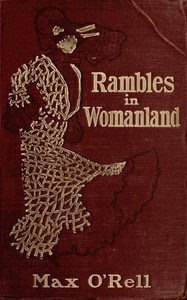
Rambles in Womanland by Max O'Rell
Published in 1893, Rambles in Womanland isn't a novel with a plot. Think of it as a guided tour. Max O'Rell acts as your cheeky, mustachioed guide through the landscape of womanhood as seen through the eyes of a late-Victorian gentleman. He structures his 'rambles' as a series of short essays and observations.
The Story
There's no traditional story here. Instead, O'Rell picks a topic—like 'Why Women are Better than Men,' 'The Art of Managing a Husband,' or 'The Tyranny of Fashion'—and just runs with it. He uses humor, anecdotes, and sharp social commentary to explore the roles, strengths, and perceived mysteries of women. He often compares French, English, and American women, poking fun at national stereotypes. The 'journey' is his attempt to logically understand a sex he finds fascinatingly illogical (by his own admission), and the 'destination' is a mix of admiration, bewilderment, and a call for better education and respect for women.
Why You Should Read It
This book is a time capsule, and that's what makes it so compelling. You're not reading it for modern relationship advice. You're reading it to hear a specific, charismatic voice from history. O'Rell is funny. His wit is dry and his comparisons are often spot-on, even when his underlying assumptions make you raise an eyebrow. What surprised me was his relative progressiveness. While firmly a product of his era, he consistently argues that women are intellectually equal to men, critiques the silly constraints of fashion, and advocates for women's education. Reading his praises of female cleverness and resilience, sandwiched between utterly dated ideas, is a fascinating experience. It makes you think about how far we've come, and what social commentary from our own time will seem charmingly archaic in 130 years.
Final Verdict
This isn't for everyone. If you're looking for a tight narrative, look elsewhere. But if you enjoy social history, vintage humor, or just a unique perspective, give it a try. It's perfect for history buffs who like primary sources that don't read like textbooks, for anyone interested in the evolution of gender discourse, or for readers who appreciate witty, conversational essays. Approach it not as a guidebook, but as a fascinating, often hilarious, conversation with a very opinionated ghost from the past. Keep your historical context glasses on, and you'll find a lot to enjoy.
Noah Davis
1 year agoI have to admit, the author's voice is distinct and makes complex topics easy to digest. A valuable addition to my collection.
Liam Anderson
1 year agoGreat reference material for my coursework.


Brian Brown
1 year agoHonestly, the arguments are well-supported by credible references. Thanks for sharing this review.