
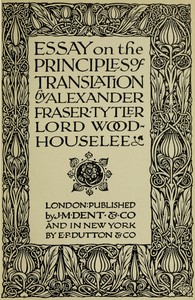
Essay on the Principles of Translation by Lord Alexander Fraser Tytler Woodhouselee
Forget dusty old textbooks. Alexander Tytler's Essay on the Principles of Translation is more like a passionate manifesto from a brilliant, slightly grumpy friend who has strong opinions about how things should be done. Written in 1791, it's his attempt to lay down the law for translators, and he doesn't pull any punches.
The Story
There's no plot in the traditional sense. Instead, Tytler sets up a problem we still wrestle with today: the eternal tug-of-war between being perfectly accurate and creating something that actually feels alive in a new language. He calls out bad translations that are either slavishly literal (and therefore awkward and dull) or wildly loose (and betray the original author's intent). To fix this, he proposes three clear rules. First, a translation should give a complete idea of the original. Second, the style and manner should feel the same. And third, it should have all the ease of something originally written in that language. He spends the book unpacking these ideas, using examples from translating poetry and prose, and arguing fiercely for the importance of the third rule—that a translation must read naturally.
Why You Should Read It
What grabbed me was how modern Tytler's frustration feels. We've all stumbled through a translated novel where the sentences are clunky, or watched a subtitled movie where the dialogue feels off. Tytler is fighting that fight 230 years ago! Reading him is like getting a masterclass in paying attention. It makes you appreciate the invisible work of good translators and gives you a framework to understand why some translations sing while others thud. It's not just about rules; it's about respect—for the original author, for the new audience, and for the power of language itself.
Final Verdict
This is a perfect little book for curious readers, writers, and anyone who loves language. It's especially great if you enjoy nonfiction that presents a clear, compelling argument. You don't need to be a translator or a scholar to get a lot out of it. If you've ever been fascinated by how ideas move between cultures, or if you just want to understand a bit more about why the books you read in translation feel the way they do, give Tytler an hour of your time. It's a classic that still has plenty to say.
Michelle Lewis
8 months agoAmazing book.






Dorothy White
1 year agoFinally found time to read this!