
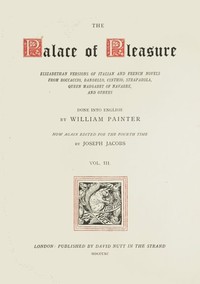
The Palace of Pleasure, Volume 3 by Painter, Haslewood, and Jacobs
Let's be clear from the start: this isn't a novel. 'The Palace of Pleasure, Volume 3' is a literary time capsule, assembled in the 1800s by editors Joseph Haslewood and Joseph Jacobs. They were building on an even older collection by William Painter. Their project was to gather and translate popular European stories from the Renaissance and earlier—tales by Boccaccio, Bandello, and Marguerite de Navarre, among others. So, you're not following one hero's journey. Instead, you're hopping from story to story. One moment you're in a Italian court watching a disastrous love affair unfold, the next you're in a French village seeing a cunning peasant outwit a greedy lord. The through-line is human nature in all its messy glory: love, betrayal, justice, and the constant, funny struggle between virtue and desire.
Why You Should Read It
I'll be honest, the old-fashioned language takes a page or two to get used to. But once you're in, the magic happens. These stories are the building blocks of so much fiction we love today. You'll read a plot and think, 'Hey, Shakespeare did something like that!' (Because he often did—he borrowed from these very sources). The characters, despite their fancy robes and formal speech, are instantly recognizable. The jealous husband, the resourceful maiden, the corrupt judge—their problems feel real. There's no authorial voice guiding you, which is strangely freeing. You get to just experience the story and decide what you think about the often wild outcomes.
Final Verdict
This book is perfect for curious readers who love history but hate dry textbooks. It's for anyone who enjoys classic literature but wants to see the raw, pulpy stories that inspired the greats. If you like anthologies like The Canterbury Tales or just enjoy falling into a Wikipedia hole about obscure folklore, you'll find a lot to love here. It's not a breezy beach read; it's a slow, savory sip of history. Think of it as a museum visit for your brain, where every exhibit is a short, dramatic story that has survived for centuries. Just be prepared to have your favorite one and to wonder, endlessly, about all the storytellers whose names we'll never know.
Michael Smith
7 months agoHaving read this twice, the arguments are well-supported by credible references. Exceeded all my expectations.
Mary Clark
1 year agoThe index links actually work, which is rare!
Jennifer Ramirez
5 months agoVery helpful, thanks.
Karen Hill
1 year agoI started reading out of curiosity and the narrative structure is incredibly compelling. I would gladly recommend this title.






Susan Davis
7 months agoFive stars!